


So, you want your reader to feel things when they read your novel.
That’s pretty much a writing edict right there and we’re going to run with it, okay?
Why do emotions matter?
The Writing King (What a name, man!) writes, “"Emotions are the heartbeat of your story. They breathe life into characters, add depth to plot, and bind readers to the narrative. When readers feel what the characters feel, they invest. They want to know what happens next. They fear, hope, laugh, and grieve alongside people who don’t exist — and that emotional investment is what makes a story unforgettable.”
The emotion of the story creates the tone of the story.
“A scene written with joy lifts the reader. A scene written with suspense puts them on the edge of their seat. A scene written with grief moves them to tears. Without emotional texture, even the most inventive plot reads like a sequence of events happening to people nobody cares about.”
The emotion comes from the characters. But it also comes from the setting, the mood, the sentences, the word choices.
FIRST WAY TO DO THAT
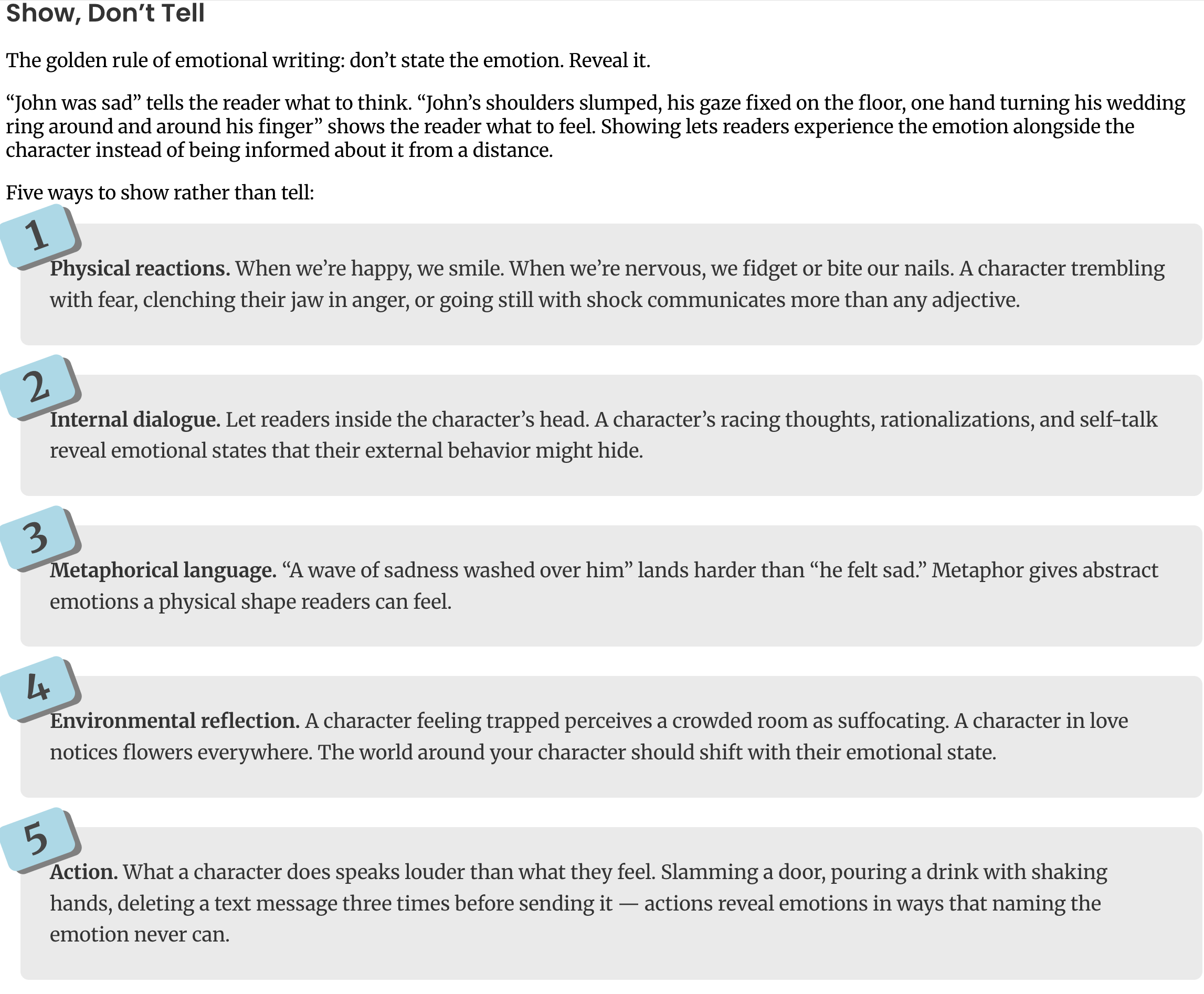
One of the big secrets to making your readers feel is to show what’s going on rather than tell them what’s going on.
ANOTHER HINT: GET SMART ABOUT EMOTIONS YOURSELF
K.M. Weiland suggests that “you can’t write what you can’t feel.”
She spent decades bragging that she never cried. Then, she did. She had to build up her understanding of emotions to become a better writer.
She writes, “For me, one of the biggest revelations was that emotions are something that happen in the body. I’d always sort of imagined them as ephemerae floating around my head somewhere, rather than as physical sensations (which shows you how disconnected I was). Indeed, one of the reasons we often don’t want to feel our feelings is because they literally hurt in the body. When we talk about being willing to feel our feelings, we’re talking about feeling tension trapped in the body which can only be released when we are willing to feel it.
“One of the easiest ways to do this is ‘body scanning.”’ When you sit down to write an emotional scene, take a moment to close your eyes and scan your body from head to toe, noticing and naming any sensations you feel. You aren’t necessarily looking for emotions; rather, you’re trying to raise consciousness around physical sensations. If you’re cut off from emotions, it’s because you’re cut off from your body. The act of vocally naming sensations helps promote a mind-body neural connection that makes it easier and easier to raise real-time emotional awareness. This process might sound something like this, ‘I feel cold in my toes, tingling in my knees, lots of energy in my belly, tension in my spine, lightness in my chest, pressure in the crown of my head.’ Don’t worry if you don’t have exactly the right words, since the whole point of the process is to familiarize yourself with sensations that may feel very unfamiliar.”
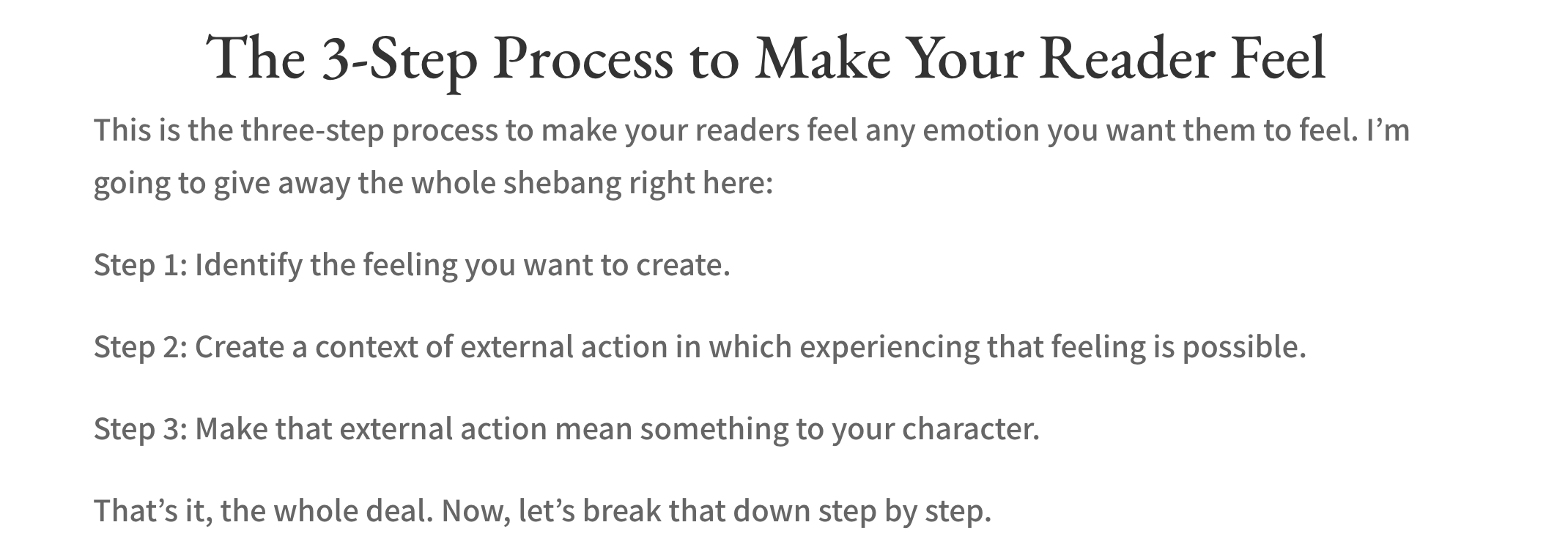
A THREE-STEP FORMULA
Alice Sudlow created a formula over on her website.
MAKE THE CHARACTER RELATABLE
Usually, the stories that we cry over have characters that we cry over.
As Famous Writing Routines explains, “Emotional impact begins with characters readers care about. If readers don’t connect with your characters, they won’t feel much when those characters succeed, fail, or face danger. Give your characters relatable flaws, desires, and struggles. Show their vulnerabilities, their fears, and their hopes. When readers see themselves in your characters, they’ll feel what your characters feel.”
And there you go! :)
QUICK NOTE.
This blog/newsletter/Substack/whatever will always be free to read (except for Saturday’s writing posts, but it’s also how I pay my bills. If a paid subscription is way too big an ask, I’m always thankful for help buying dog treats. Or, honestly, just sharing that this Substack exists is cool.
I usually send these emails twice a week.
*My WRITE BETTER NOW posts also come twice a week if you sign up for them, too, which you should.
And COMFORTING is where I just have no filter at all and am totally schmaltzy is here. That’s once a week or so.